
“Truth and Justice” is the story of an uncompromising man whose soul is corrupted by the relentless pursuit of his dream.
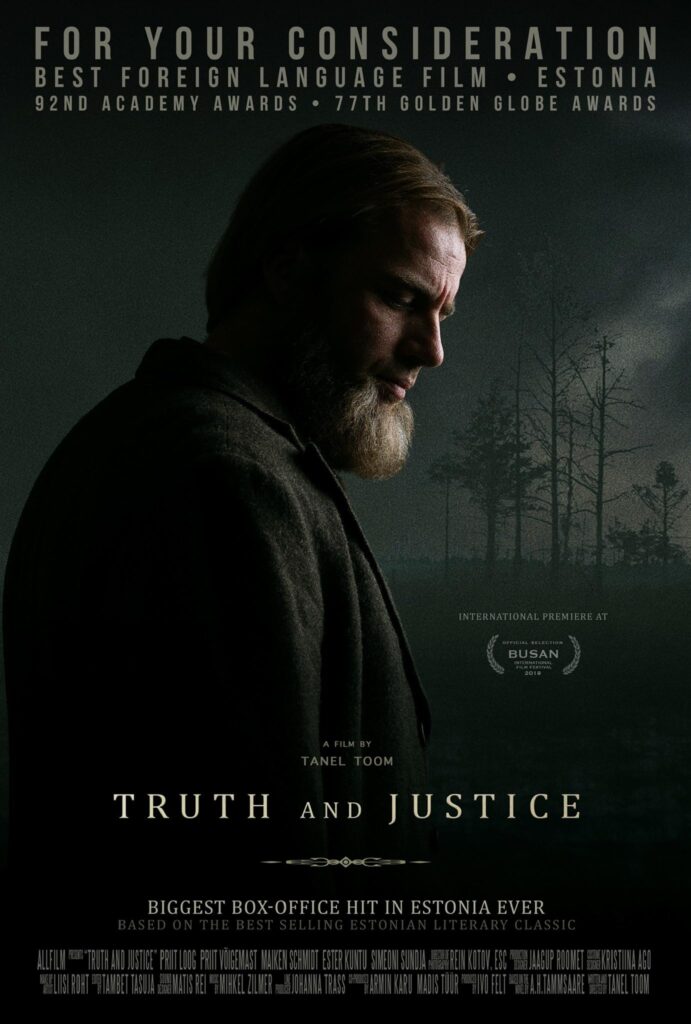
Estonia, 1870. Young and staunch Andres along with his wife Krõõt arrive at a farm bought on a loan to establish their new life. Desolate and neglected between the marshes, Robber’s Rise must be transformed into a place that will take care of the family. All they have to do is to break the resistance of the barren land, make his neighbour cooperate, and raise an heir – a son to inherit his father’s life’s work. But when nature refuses to bend, the neighbour turns out to be a roughneck rival, and Krõõt keeps giving birth to daughters, Andres struggles to find the right way. In his desperate search for truth and justice – from the court, the tavern and the Bible, he sacrifices his family, his friends and eventually himself. The beautiful dream of prosperous and nurturing Robber’s Rise gives way to an obsession, resulting in none of the things Andres wanted and everything he was afraid of.
Director & Screenwriter: Tanel Toom
Cinematographer: Rein Kotov
Production Designer: Jaagup Roomet
Costume designer: Kristiina Ago
Make-up artist: Liisi Roht
Composer: Mihkel Zilmer
Sound Designer: Matis Rei
Editor: Tambet Tasuja
Co-producers: Armin Karu, Madis Tüür
Producer: Ivo Felt
For a long time, it seemed that James Cameron’s 2009 film “Avatar,” made with a budget of $237 million and seen by 194,327 viewers in Estonia, would remain the country’s record-breaking film. But then came Tanel Toom’s “Truth and Justice,” made with at least 2.5 million euros, which shattered both opening weekend and opening week viewership records—and not only that: the film based on Anton Hansen Tammsaare’s novel, which premiered in cinemas on February 22, has now attracted approximately 250,000 viewers to theaters, making it the most-watched film in the history of Estonia since regaining independence.
But none of this came easily. The creation story of the film, born from the work of hundreds of people, is long and complex, and a very large role in the film’s birth was played by Frost FX, responsible for visual effects. Their work should not be underestimated in any way, because through the joint efforts of these men and women, “Truth and Justice” became the film that not only shattered viewership records but can also be called one of the strongest debuts of all time.
During my visit to the Frost FX office, there wasn’t a single computer screen that wasn’t running footage from “Truth and Justice.” According to the film’s effects team leader Heiki Luts, it’s natural that after the premiere, work continues on refining the effects. Although the cinema version seems perfect, it too has errors or places that need improvement, which only film industry professionals notice. They have been giving feedback to the filmmakers after the premiere because they notice what escapes the average audience’s attention.
Frost FX’s work largely began when it was known which buildings from the Estonian Open Air Museum would be used to create Pearu’s farm buildings, for example. The buildings needed to be digitized, and this was done two and a half years ago. Initially, three models were made, which later had to be added to footage shot in South Estonia, where there weren’t actual farm buildings but blue cubes. These later served as references for where the buildings were located and where and against what background the action took place, making it easier to digitally add real buildings to the frame.
If blue-painted buildings or blue cubes hadn’t been used during filming, it would have been very difficult to get the shots right because it wouldn’t have been clear where a building began and ended. Simply adding something digitally is complicated. Landmarks also had to be left in the frame to indicate location. Visual effects are done in post-production, but for it to succeed, cooperation is needed before filming and of course during filming as well.
“Actually, an interesting fact is that one week before the premiere, we were still shooting against a blue screen to film spruce branches,” laughs Heiki Luts, the effects team leader of “Truth and Justice.” Why was it necessary to film spruce branches a week before the premiere?
According to Luts, it was for the scene where Andres and Mari find a dead horse. This was a very important moment in the film because it deepened Mari’s fear that her and Andres’s life together hadn’t given Juss’s soul peace. At the end of the scene, we see the dead horse in the frame and a creaking spruce tree to the right, which the camera slowly approaches. In one take, Andres, Mari, and the dead horse were filmed, and in another take, the camera’s approach to the spruce. Since Andres and Mari had to be placed behind the spruce branches, the only way to make the effect work was to add branches filmed on blue to the existing spruce. To add the branches to the frame, the team needed nothing more than to go outside their building and film spruce branches against a blue background and add them to the frame. “Truth and Justice” is full of tiny digitally added details that even the sharpest eye couldn’t catch.
According to special effects supervisor Heiki Luts, the first meetings regarding the screen adaptation of Anton Hansen Tammsaare’s novel took place three years ago, and even before the filmmakers approached them, it was clear that they were thinking of the Frost FX team.
Previous collaborative films between cinematographer Rein Kotov and the Frost FX team included, for example, Elmo Nüganen’s “1944” and Moonika Siimets’s “Comrade Child.” Since the filmmakers were already familiar with each other, information reached the effects wizards even before discussing official cooperation that something was coming. That “something” was “Truth and Justice,” made with almost 2.5 million euros.
According to Heiki Luts, they took on “Comrade Child” before starting work on “Truth and Justice,” but since the team is large, it’s completely normal to work on multiple projects at once. One is worked on more thoroughly while preliminary work quietly begins on another.
“We have enough people, we can keep multiple things going at once, and from the company’s perspective, it’s also necessary. If one project ends, ideally there should be something that immediately follows. Otherwise, you start running toward bankruptcy,” Luts acknowledges.
What’s interesting about working on multiple films at once is that effects recorded for one film can end up in another in one form or another.
“The sky in the Town Hall Square scene in ‘Comrade Child,’ where Leelo watches people passing by, is actually the bog sky from ‘Truth and Justice.’ If you removed the buildings, you’d see Vargamäe bog,” laughs Luts when he sees my surprised expression. It’s truly surprising that even the most ordinary shot actually contains multiple effects: the sky, buildings, and even people have been added. They’re not noticed because they don’t draw attention to themselves.
According to Luts, director Tanel Toom masters all aspects of filmmaking fairly well, from sound to special effects. “We wouldn’t have gotten the film finished if Tanel hadn’t taken static frames from the filmed material and added his vision through Photoshop of what he would like to see digitally added,” Luts believed.
Toom combined shots captured during filming with his vision of where to add, for example, forest, bushes, trees, buildings, etc. This was invaluable help for Frost FX because it conveyed the director’s vision of the frame he wanted to see in the film but which couldn’t be captured during filming for logistical, practical, financial, and many other reasons.
Now it was the task of Frost FX artists and technicians to take the material gathered during preliminary work, Toom and Kotov’s vision of each frame, and put together the film that has now been seen by approximately 250,000 viewers.
The Frost team can be called artists because what they do is truly art. However, according to Luts, they are more like technicians because they didn’t have much creative decision-making space. Cinematographer Rein Kotov and director Tanel Toom had thought through every frame’s effects so that Frost FX could put them together in a short time. Projects with plenty of time to be creative themselves are very good, but since there wasn’t time for that in this case, it was good to receive feedback for time-saving purposes on how the frame should look.
“If we had had to start inventing this world from scratch ourselves, the whole process would have taken much more time,” Luts acknowledges.
Creating effects doesn’t consist of sitting behind a computer and digitally supplementing frames. Frost FX also attended the filming, but since the film crew was very effects-aware, they didn’t need to be there very long to give tips for simplifying later work. Everything was under control on the “Truth and Justice” set in that regard.
Even if a director is very effects-aware, their attention should still be on the film’s most important aspects, like directing and working with actors. That’s why technical questions should be handled by a professional in the field who makes sure the shot is captured in a way that yields the best result.
This also applies to tiny details. Even filming a spruce tree isn’t as simple as it seems. The film’s spruces and spruce branches were largely the responsibility of compositor (a person who places elements into one frame) Ragnar Neljandi; Vahur Kuusk also added spruces, which seems entirely appropriate given his surname. At one point, Kuusk even sent Luts a video of a spruce in front of his house that he hadn’t even noticed because the window facing it was covered with a curtain. Fortunately, those spruce branches visible from the window weren’t the right ones for the film anyway.
There are more such invisible effects in the film, for example, the grave visible at Krõõt’s funeral, which didn’t actually exist. Under the coffin was a green cloth where a hole was later added. Wouldn’t it have been easier to dig a grave? Actually not, because the filming took place in a cemetery and there was no permission to dig there. The other option would have been to build an entire cemetery for the scene, but that would have been more complicated and expensive in the end.
This explains when and why visual effects are used when filming seemingly very simple situations. While this makes the actors’ work harder because during filming they only see blue houses, blue screens, and green cloth, nothing in the acting of Priit Loog, Priit Võigemast, and Maiken Schmidt revealed that the preliminary effects work used during filming had disturbed them.
This wasn’t the first time Frost FX had to digitally dig graves for a film by Tanel Toom and Rein Kotov. The first time was in the 2008 short film “The Second Coming,” which also needed grave sites created, as well as some digitally added flies.
However, creating visual effects doesn’t only include creating and adding spruce branches, horizons, flies, backgrounds, buildings, and everything else visible in the frame; sometimes actors’ performances must also be corrected. If there are multiple takes of one shot and in one take you can see that the actor is looking in the wrong direction, this can be corrected very simply by combining two takes.
This happened, for example, in a dialogue scene where Mari’s head moves in the wrong direction in one shot. Mari is talking to the children, but during the conversation, while responding to a child, she looks in the wrong direction toward the other child. To fix this, Mari’s head was taken from one take and replaced in the original shot so that one head was swapped for another. There are many such scenes in the film: several tavern scenes actually consist of multiple similar takes, but if one was right and the other wrong, they were swapped and combined. The viewer doesn’t realize this and doesn’t need to, because the shots are all virtually the same with small differences.
In terms of effects, the biggest challenges were scenes with snow and two iconic spruce trees. Creating snow required daily morning meetings where they discussed how to make the snow better. Fortunately, Alejandro Echeverry, a specialist in digital liquids and snow from Colombia with whom they collaborate on almost every project, came to help. He prepared a tool that could change the amount, consistency, and appearance of the snow.
The second major challenge involved the Vargamäe spruces and especially a three-second shot where, against the backdrop of a lightning-flashing night sky, a tree is cut down by Andres. This couldn’t be captured in reality, so the night, thunder, and spruce had to be digitally assembled. Initially, they hoped all spruce shots could be done with the same spruce, but it turned out that close-ups of spruces were believable, but from a distance they seemed fake.
It’s very difficult to create a spruce from scratch or find one in nature and make it digitally believable when a falling spruce can’t be filmed in reality. Every time they thought they’d found the right spruce to fit into the falling shot, it turned out it still didn’t work. The reasons varied: the spruce itself was suitable but the top was wrong, or the top was right but the spruce branches were wrong. And when the right one was found, it was difficult to digitally simulate the spruce falling, which made the whole process very complex.
Finally, doubles of two spruces were used, which are also used in the film in all shots where we see the Vargamäe spruce. These spruces were sent to an Indian company to be cut out of the frame. Every detail of the spruce was cut away from the background so they could then be fitted into the film as digital effects.
The three-second shot of the falling spruce was completed as a simulation in a program, placed in nighttime, and also added with perfectly timed momentary thunder at the beginning.
It’s digitally difficult to create a spruce because graphics engines can’t create a spruce that would simulate growing from a shoot, years of wind and storm effects, human activity effects, and naturally malformed branches. A spruce is like a human face, into which life’s experiences are written. In the end, an almost perfect version was achieved, but since work on it was still in progress, a quick shot of a digitally created falling spruce was used in the film. The final version was quite believable, but according to Luts, it could have been better.
There are over 60 shots in the film that involved all the windows of houses or night shots related to snow. Every window interior had to be filled separately, either with different versions of snow or simply with the right background.
For example, in the shot where we see Andres arriving home at night. This is the moment when he already knew that a relationship had developed between his daughter and Pearu’s son, and he was deciding how to proceed with Mari. We see Andres in this shot looking toward Pearu’s farm before entering his own house.
The snow we see there is all added later. This wasn’t a simple task either. First, the shot was sent to an Indian company where everything in the frame was quickly cut out: Andres, horse, buildings, etc. Then falling snow was placed into it in Estonia, but it couldn’t simply fall in the foreground. Snow must fall everywhere: in front of the camera, in front of Andres, behind and beside him, in front of and beside the house, in front of and beside the horse. A good effect doesn’t draw attention to itself but amplifies what’s already there.
However, many scenes are much more complicated than simply adding a bush or blade of grass. For example, many night shots were actually filmed during the day. There are several logistical reasons for this, including that actors can get all their scenes done during the day instead of filming at night. Frost FX’s task was to turn day into night—to add a setting sun or even a nighttime sky and also change the lighting to nighttime.
“Moon and sun lights are actually very similar, or rather their character is very similar. What differs is the brightness level of darkness and tonality,” Luts believes.
Replacing the sky in night shots was simple because the sky was blue in daytime shots, and blue is meant to be replaced with effect shots. Night shots filmed during the day create a controlled environment where effects creators can easily change the skyline, time of day, and everything else to turn day into night. This couldn’t be done with shots filmed at night.
Twenty-five people worked on the Frost FX team for “Truth and Justice,” including effects masters from Greece, Colombia, and Egypt.
One might expect that team members’ favorite effect shots would be something grander and more eye-catching, like the falling spruce on a thunderstorm-lit night, but for Luts it was the moment when Pearu runs toward the ditch with his farmhand when he realized that Andres was going to take down the dam blocking the water flow. Buildings, horizon, grass, sky, and a stone fence were added to this shot, and on top of everything, it’s also with a moving camera, but everything worked beautifully.
Additionally, Luts highlighted buildings in the background of characters that were added later. For example, in the scene where Pearu’s wife, rushing on a horse cart, quickly opens the gate for the man. Favorites also include a shot with Andres leaving Pearu’s yard. Buildings from the Open Air Museum were added there, for example, and with this shot, no one doubts whether they’re actually there.
Frost FX struggled with every shot for months and years, and now it can be proudly acknowledged that approximately 250,000 people have seen the film and these effect shots created with great care and love.
VFX Producer
Heiki Luts
VFX Supervisor Assistant
Juss Saska
Visual Effects Assistant
Sandra Leušina
Compositors
Martin Turu, Egert Kanep, Vahur Kuusk, Mikk Punning, Anti Rannus, Tauno Ööbik, Ragnar Neljandi, Raivo Möllits, Villem Tammaru, Anton Shtolf
3D Simulations
Andres Kluge, Alejandro Echeverry
3D Models
Evgeny Kovalev, Khaled Rizk
Software Engineer
Kalev Mölder
Link to original article in Kroonika
Story author: Ra Ragnar Novod
Photo and video: Madis Veltman
Video story: Madis Veltman
Graphics and design: Heleri Kuris, Ats Nukki, Mart Nigola
Editor: Kristi Helme
Ekspress Media Creative Director: Mihkel Ulk
Thanks to: Frost FX, Allfilm
Photos used: Allfilm, Madis Tüür, Heikki Leis

PRODUCTION COMPANY — Fisherking, Amrion, Three Brothers, Beta
DIRECTOR — Måns Månsson
VFX — 3D, water simulation, compositing
PRODUCTION COMPANY — Amrion
DIRECTOR — Moonika Siimets
VFX — 3D, water simulation, compositing