
The Soviet Union is likely to collapse and Baltic nations struggle to take back their lost independence. Soviet Union's basketball championship is set to begin while Public opinion opposes the Estonian national team's participation
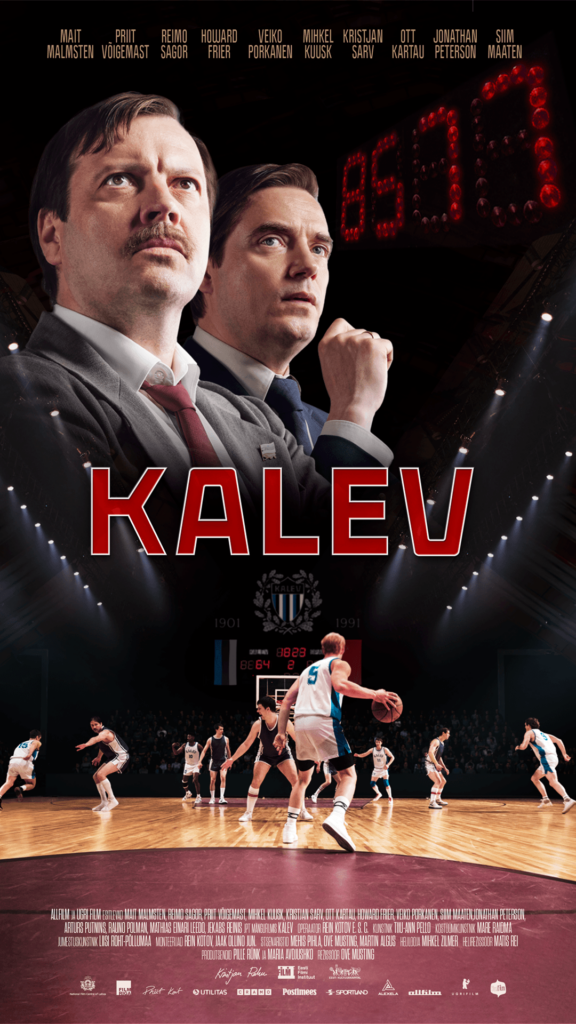
It’s the summer of 1990. The Soviet Union is teetering on the verge of collapse, while the little Baltic nations struggle to take back their lost independence. The Soviet Union`s basketball championship is set to begin on the backdrop of a deeply divided society.
The Estonian team Kalev faces a momentous decision. With Estonian independence seemingly within reach, a rising tide of public opinion opposes the Estonian national team’s participation in the USSR’s championship. That would contradict the people’s aspirations for liberation. As professional athletes, the team makes the unpopular choice.
The championship games start…
Director: Ove Musting
Cinematographer: Rein Kotov
Production Designer: Tiiu-Ann Pello
Producer: Pille Rünk
Co-producer: Maria Avdjushko
Cast: Mait Malmsten, Reimo Sagor, Priit Võigemast, Mihkel Kuusk, Veiko Porkanen, Kristjan Sarv, Rauno Polman
The first test shoots were filmed at the Kalev sports hall, but then came the coronavirus pandemic. The whole world was locked down, including the sports hall doors. Heiki Luts, producer at Frost FX, the company responsible for the film’s visual effects, recalls that after the coronavirus pause, it was no longer possible to close the actual event location for such a long time for shooting purposes.
So how exactly was the home court of the Kalev basketball team built between the walls of Saku Suurhall? To do this, scans of the Kalev hall had to be placed inside scans of Suurhall.
“We had to use Saku Suurhall as much as possible, including those seats that were already there,” says Luts. “We saw that we could use one existing stand. According to that, we built the court and on the other side we physically built three rows of stands from scratch,” he explains.
The remaining rows had to be built by the special effects masters later on the computer.
But in addition to building the stands, they also had to be filled with people. Coronavirus restrictions allowed 450 people at mass shoots at the time, but at the famous Kalev final game, there were over ten times more in the hall.
“By the time we finally started making the audience, a couple of years had already passed due to corona and we had developed our digital human further,” Luts chuckles. “That’s why we were convinced that we didn’t need so many real people.”
Luts admits that making a human is always the biggest challenge.
“We’re used to seeing and looking at people, so we’re also critical when something doesn’t seem quite authentic,” explains Luts. He himself always prefers real people in films over digital figures, but the hybrid form used was optimal in his opinion, considering the pandemic and cost savings.
If choosing today, would the cameras still be set up at the Kalev sports hall? “Good question. We’d have to look over the Kalev hall with fresh eyes,” Luts muses. “But maybe it would still be easier to go to Saku Suurhall. The narrow Kalev hall would have limited us in camera work. It would have also made it more complicated to make the ‘digital audience’ believable, they would have been closer to the camera and players. Now we were able to lift them further away and into darkness.”
Before the shooting period began, Frost FX’s special effects wizards had to make one difficult decision about the background to be used on set. While green or blue screens are typically used on film sets, black fabric was used in the film “Kalev.” “If you go watch even a Hollywood movie and follow, for example, a person’s face outline and if it doesn’t look very natural, you can be sure the background was blue or green,” explains Luts. Using black fabric appears much more natural in the final result.
“In addition to blue and green being bright colors, they also need to be lit when used on set, and that glow can be seen on the edge cut; with black, the transition is more natural,” says Luts.
Another factor in favor of black fabric was that a blue or green background would have reflected off the basketball court.
The third and most practical reason was that Saku Suurhall simply had enough black fabric to set up as a background. “We would have had to start buying blue fabric and in such quantities it wouldn’t have been sensible,” Luts notes.
Although black background had many advantages in the context of the “Kalev” film, it meant a lot of extra work for the special effects team, because working with a blue or green screen is much more time-saving. In total, there were about 25 minutes of game footage that had to be cut frame by frame. “In one second there are 25 frames, which means 25 cuts for each film second. Every person or object that remained in the foreground had to be cut out,” explains Luts about the volume of work. “In our work, every second is complicated, every frame is relatively complicated to produce.”
The time pressure was intense. “We were able to start work in March and had to be ready by fall. The main thing about the project was Martin Turu, he had his summer interrupted. He had no chance to be away for a moment, thanks to him we were able to finish it,” Luts shares praise toward his colleague.
But Luts also says that when making a domestic film, it’s significantly easier to ignite the team. “We’ve made all sorts of Hollywood films, but the heart still yearns for Estonian projects. It’s always been a particularly warm feeling making Estonian films. It can’t be compared to foreign projects in any way, it’s somehow more soulful and heartfelt.”
But in addition, some of the special effects were also assembled in Ukraine. Namely, Frost FX had previously worked with a Ukrainian company. When the war broke out, the Ukrainians didn’t take on new work, but then part of the local team moved to Poland and others continued working from home. “It was good to give them work during such a difficult time. They even said it kept them engaged,” says Luts. “They did very good work and without them it would have been much harder to put it all together.”
VFX Producer and Supervisor — Heiki Luts
VFX Supervisor, Compositor TD and 3D Lead — Martin Turu
VFX Producer and Coordinator — Sandra Leushina
CG Crowd Simulation — Andres Kluge
Pipeline TD — Kalev Mölder
Compositing Supervisor — Nick Kostomarov
Compositing Producer — Mariia Horelenko
Compositors
Anton Shtolf, Philip Filimonov, Ragnar Neljandi, Vahur Kuusk, Villem Tammaru, Oleksandr Saltykov, Mariia Nesmachna, Oleksandr Tromsa, AnnaDorokhova, Roman Oberemchenko, Alicja Noworzyn
Iryna Syrotiuk
3D Artist — Egert Kanep
3D Artist — Anti Rannus
Matte Painting — Kait Kybar
Matchmove and Roto — Suneel Kumar Sahu
Matchmove and Roto — Dave Kapil
Matchmove Assistant — Kaspar Raudsik
3D Modeling Assistant — Mikk Punning
3D Modeling Assistant — Kaarel Raudkivi
VFX Coordinator Assistant — Margareth Villers
Technical Support — Andrii Volodin
Technical Support — Juss Saska
LIDAR Scanning — Karl Stokkeby
Link to original article in Eesti Ekspress
Author of the Story
Laura Kalam
Graphics and Design
Karl-Erik Leik, Mart Nigola

PRODUCTION COMPANY — Fisherking, Amrion, Three Brothers, Beta
DIRECTOR — Måns Månsson
VFX — 3D, water simulation, compositing
PRODUCTION COMPANY — Amrion
DIRECTOR — Moonika Siimets
VFX — 3D, water simulation, compositing